
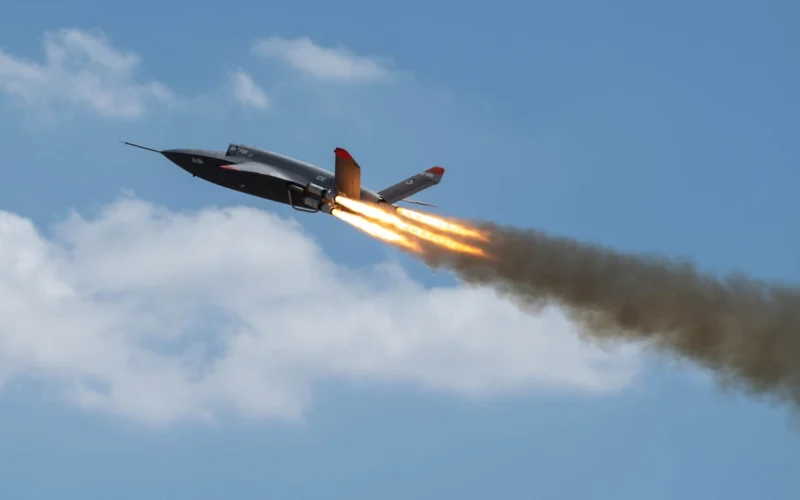
A US Marine took control of a Kratos Valkyrie drone beyond line of sight as it flew an electronic warfare mission alongside F-35s and an F/A-18 at a US Navy test range in southern California, the manufacturer revealed on August 18, 2026.
The April 2026 flight began with the missionized United States Marine Corps (USMC) Valkyrie collaborative combat aircraft (CCA) launching from a zero-length launcher. The runway-independent aircraft later returned autonomously to its recovery point.
During the mission, the uncrewed jet flew with multiple USMC F-35 fighter jets and an F/A-18 while the test team completed coordinated electronic warfare objectives. Kratos did not identify the payload or the specific Valkyrie configuration used.
Control passes from Kratos to a Marine operator
Once the Valkyrie was airborne, control passed from a Kratos ground control station to a human-machine interface developed by Autonodyne and compliant with the Autonomy Government Reference Architecture.
The handover allowed the Marine operator to fly the aircraft over a beyond-line-of-sight (BLOS) link while the test team validated and characterized the command-and-control datalink.
An integrated test team led by the Expeditionary Maritime Aviation-Advanced Development Team conducted the mission. It included a USMC operational test and evaluation squadron, US Naval Air Test and Evaluation squadrons, Northrop Grumman, Autonodyne and Kratos.
Kratos said the flight took place at a US Navy test range in southern California but did not identify the facility or explain why it waited four months to disclose the results. Neither the USMC nor Naval Air Systems Command had publicly confirmed the test when the release was issued.
Test result disclosed two weeks after Valkyrie crash
The announcement came two weeks after an XQ-58 Valkyrie crashed at the US Army’s Dugway Proving Ground in Utah on August 4, 2026, prompting Kratos to suspend Valkyrie flight testing.
The aircraft involved in the Utah accident took off from a runway in a company-funded test configuration. The USMC aircraft used for the April mission launched from a zero-length launcher. Kratos has not connected the two events.
Steve Fendley, President of the Kratos’ Unmanned Systems Division, said the April flight marked the fourth new mission-system configuration flown on USMC Valkyrie platforms in under three years.
US Marine Corps picks Valkyrie team for CCA program
The US Marine Corps selected Northrop Grumman and Kratos in January 2026 for its Marine Air-Ground Task Force Uncrewed Expeditionary Tactical Aircraft (MUX TACAIR) CCA program. Kratos said the first prototype air vehicle remains on track for completion by the end of summer 2026.
Fendley also said Kratos expects to deliver more than 150 Group 5 unmanned jet aircraft in 2026 and is expanding production capacity toward approximately 40 Valkyries a year. Kratos is separately developing a Valkyrie variant with Airbus for the German Air Force.
Two months after the Valkyrie mission, another CCA joined an even larger formation of crewed aircraft. Boeing said on July 7, 2026, that its MQ-28 Ghost Bat flew during Exercise Valiant Shield 2026 in June, operating around the Marianas Island Range Complex alongside F-35A, F-35B, F-15EX, E-3, E-2D, EA-18G and RC-135 aircraft. Boeing described it as the first CCA deployed to a multinational, joint operational exercise.