

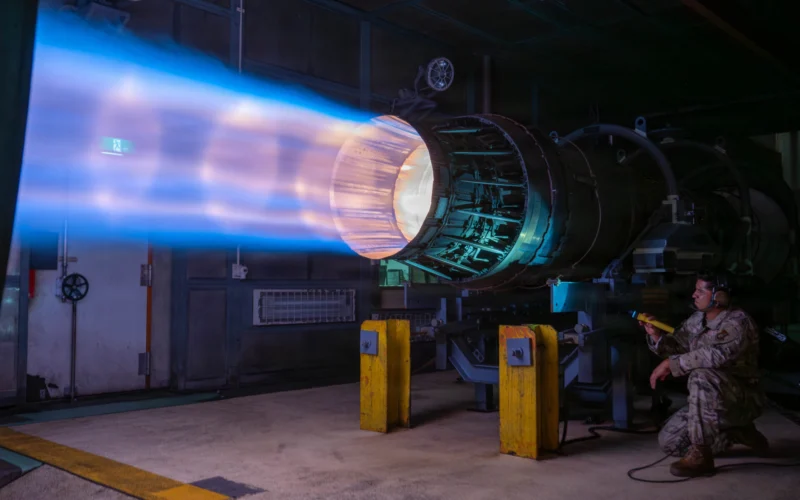
The US Air Force is preparing to open fighter engine production for the F-15EX Eagle II and F-16 Fighting Falcon to competition, citing delays, quality control problems and disappearing suppliers in the industrial base it relies on today. Combined US and foreign demand could exceed 180 engines a year by fiscal year 2034.
The US Air Force Life Cycle Management Center published a request for information on August 3, 2026, asking which companies could develop, produce and sustain engines for US Air Force and Foreign Military Sales aircraft. Responses are due by 2 pm EDT on August 28, 2026.
The current propulsion industrial base, the notice says, has delivered late, has struggled with quality control, and has run into critical obsolescence, meaning suppliers and materials that are no longer available. What the US Air Force proposes instead is a “strategic competition” designed to pull it away from legacy procurement and force manufacturers to invest in new technology and capacity.
Twelve engines a year, or 180
Companies must show how their pricing and manufacturing hold up across four production bands: one to 12 engines a year, 13 to 48, 49 to 96 and 97 to 180. The service wants to know at what volume private investment in new facilities, tooling and automation begins to make sense, and it wants the same answers from the tiers below, down to the foundries and forge shops.
It also asks where the choke points sit: specialized titanium and nickel alloys, advanced casting and forging capacity, and any component available from a single source or a foreign one. Respondents owe a schedule for qualifying their engine on both the F-15EX and the F-16, including the airworthiness testing needed to amend each aircraft’s military type certificate.
Fixed annual quantities are not on offer. The US Air Force is weighing order volumes tied to each supplier’s performance, and has asked companies to propose the incentives themselves, covering delivery punctuality, quality and responsiveness to operational requirements. It also wants a live feed of manufacturing data.
F100 and F110 could face a new contest
The RFI lands as the US Air Force expands its F-15EX buy to as many as 267 aircraft while brokering engine deals for a widening list of foreign F-15 and F-16 operators. GE Aerospace already holds a $5 billion ceiling contract, awarded in March 2025, covering F110-GE-129 engines and associated equipment for Foreign Military Sales customers including Saudi Arabia, Jordan and Bulgaria, running to December 2030.
The F110-GE-129 remains the only engine fully integrated and certified on the fly-by-wire F-15EX. Pratt & Whitney, however, continues to promote the F100-PW-229 as an alternative for the F-15EX, although selecting it would require additional integration and certification work. The engine is also offered for new-build F-16s.
The US Air Force named no bidders and prescribed no architecture, and its own document asks for a “new engine solution” without saying whether that means a new variant, an upgraded design or a clean sheet.
The warning comes amid broader strain across the US military engine sector. All 123 Pratt & Whitney F135 engines delivered for the F-35 in 2024 arrived late, by an average of 238 days, while contracts for subsequent production lots were also delayed by around six months.
2 comments
Not Pratt. We did an FSE in 1997 on two F-15E aircraft modified with G.E. F110-129 engines. The G.E.’s outperformed AND outlasted the pratt F100-229’s with ease. They need to leave this as it is planned.
I hear the Nee F-15 EX Is a superior aircraft at a 4+ rating. It should get a 5 rating in my books.