
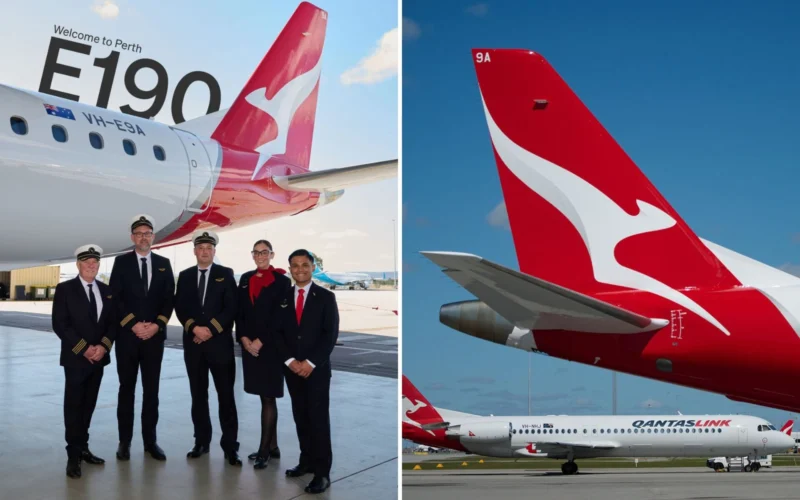
QantasLink’s first Embraer E190 touched down in Perth on September 7, 2026, marking a major milestone in the airline’s plan to replace its aging Fokker F100 fleet across its Western Australian resources charter operations.
The aircraft, registered VH-E9A, completed a 20-hour delivery journey from Norwich, United Kingdom, making stops in Bulgaria, Tajikistan, India, Malaysia, and Broome in Western Australia before arriving in Perth.
Up to 14 mid-life E190s, of which this is the first, will progressively replace QantasLink’s F100 fleet, with the aircraft scheduled to enter commercial service from January 2027.
Wi-Fi, Economy Plus, and new seats: what the E190 brings to regional WA
Every E190 will undergo a cabin refresh before entering service, bringing a range of upgrades which, QantasLink claims, will represent a generational leap over the outgoing F100s.
The 100-seat jets will feature new, more spacious seats with adjustable headrests, USB-A and USB-C charging, and personal device holders. Wi-Fi will be installed on each aircraft, allowing passengers to stream content on their own devices through the Qantas Entertainment App.
The aircraft will also introduce Qantas Economy Plus to the regional charter network, offering customers more legroom, priority boarding, and priority access to overhead baggage space.
18,000 hours of training underway as WA crews prepare for fleet transition
The fleet transition is also creating significant training and development opportunities within Western Australia.
Approximately 70 pilots, cabin crew, and engineers will receive a combined 18,000 hours of training by the end of the year to operate and maintain the initial E190 fleet. Once the program reaches full scale, more than 600 personnel could be trained on the type.
Trevor Worgan, Chief Operating Officer and Regional General Manager of Network Aviation Australia, said the E190 represents more than just a fleet swap. “For almost 20 years, the F100 has played a vital role connecting regional Western Australia and supporting the resources sector,” Worgan said. “Now we’re investing in the next generation of aircraft to serve our customers and communities for decades to come.”
He described the E190 as a step change in customer experience for the three million or more journeys expected to benefit each year, pointing to the improved seating, onboard Wi-Fi, and USB charging. Beyond the cabin, Worgan noted that the E190 is quieter, more fuel efficient, and can fly further than the F100, opening up new route possibilities for the network.
Continuing a Western Australian tradition
The F100 fleet, which first entered Network Aviation’s operations in 2008, prior to the airline joining QantasLink in 2011, currently operates around 120 charter and passenger services per week to more than 25 destinations across regional Western Australia. Each F100 was named after a Western Australian destination, a tradition that the E190 fleet is set to carry forward. The first aircraft, VH-E9A, was named Exmouth.
The introduction of the E190 is part of a wider investment in QantasLink’s Western Australian operations. Nineteen Perth-based Airbus A320s are also being fitted with Wi-Fi and undergoing seat and cabin upgrades, with the first expected to be completed by the end of October.