
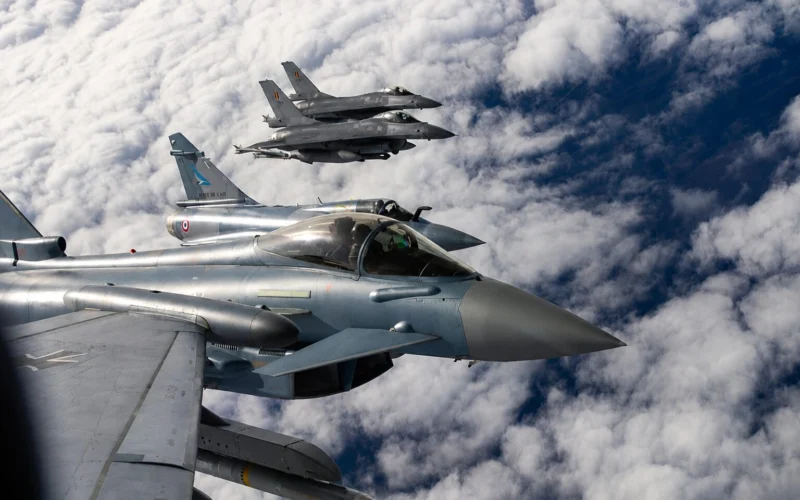
NATO fighters shot down a drone that entered Latvian airspace early on August 14, 2026, as neighboring Finland temporarily restricted aviation and maritime traffic in the eastern Gulf of Finland amid security concerns over the incursion.
Latvia’s National Armed Forces said allied fighters operating on a NATO air defense mission intercepted and destroyed the drone after an air threat alert was issued for regions close to the Russian border. The alert was later lifted.
Latvian authorities have not yet identified the type of drone, its operator or where it came from.
The aviation and maritime restrictions came as Russia reported another large-scale drone attack from Ukraine. Alexander Drozdenko, governor of Russia’s Leningrad region, said Russian forces shot down 15 drones overnight. The region borders Finland and Estonia and includes St. Petersburg, Russia’s second-largest city and a major port.
The latest incident follows a series of drone incursions into NATO airspace around the Baltic Sea as Russia and Ukraine continue exchanging drone attacks.
On June 8, a French Air and Space Force Dassault Rafale operating as part of NATO’s Baltic Air Policing mission shot down a drone that entered Latvia from Russia. Latvian authorities did not identify who launched the drone but said it crossed the border as a result of Russian electronic warfare.
A Romanian Air Force F-16 also shot down a drone over southern Estonia on May 19 after the aircraft entered Estonian airspace. Debris from the drone fell near Kablaküla village after the interception.
Finland has repeatedly imposed temporary restrictions on air and maritime traffic in the eastern Gulf of Finland when authorities believed drones operating near the Russian border might stray into Finnish territory.
During a similar incident on August 3, the Finnish Defence Forces temporarily restricted aviation and maritime traffic as a precaution to protect civilians in case a drone had to be intercepted. No drone ultimately entered Finnish airspace.
Latvia has been looking at additional ways to counter the growing drone threat. The country is considering acquiring Embraer A-29 Super Tucano light attack aircraft, in part to provide a less expensive way of intercepting slow-moving drones than using frontline NATO fighters.
NATO has strengthened air defenses along its eastern flank in response to repeated airspace violations and other security incidents since Russia’s full-scale invasion of Ukraine in 2022.