


General Atomics Aeronautical Systems (GA-ASI) has unveiled Wildfire, a clean-sheet uncrewed aircraft it is currently offering to the US Air Force (USAF) as a lower-cost, loss-tolerant successor to its own MQ-9A Reaper.
In a statement on September 10, 2026, the company declared that it had proposed Wildfire for the Massed Modular Aircraft (MMA) competition, which the Defense Innovation Unit (DIU) is running with the USAF to find an alternative to the MQ-9A.
MQ-9 losses drive search for a more expendable aircraft
The competition follows heavy Reaper attrition in Operation Epic Fury, the US campaign against Iran. Citing three US officials, The Washington Post reported on August 13, 2026, that at least 45 MQ-9s had been lost in the war, roughly a quarter of the US military’s fleet. According to the newspaper, some went down when communication links failed rather than due to enemy fire. The USAF has not published an official count.
When the USAF announced its partnership with DIU on July 9, 2026, it said that it was sustaining the current fleet through targeted repairs and buying available airframes.
Lieutenant General Chris Niemi, the service’s chief modernization officer, said future conflicts would demand “the ability to absorb operational losses while continuing to generate combat effects”.
The MMA solicitation argues that relying on “exquisite” aircraft costing more than $30 million is unsustainable against low-cost, layered air defenses. It seeks a payload of at least 1,270 kilograms (2,800 pounds), a combat radius of at least 4,260 kilometers (2,300 nautical miles) with payload, and a one-way self-deployment range of at least 14,800 kilometers (8,000 nautical miles). Initial operating capability, defined as 20 mission-ready aircraft, is targeted for fiscal year 2031.
Wildfire carries LRASM and JSM for long-range strike
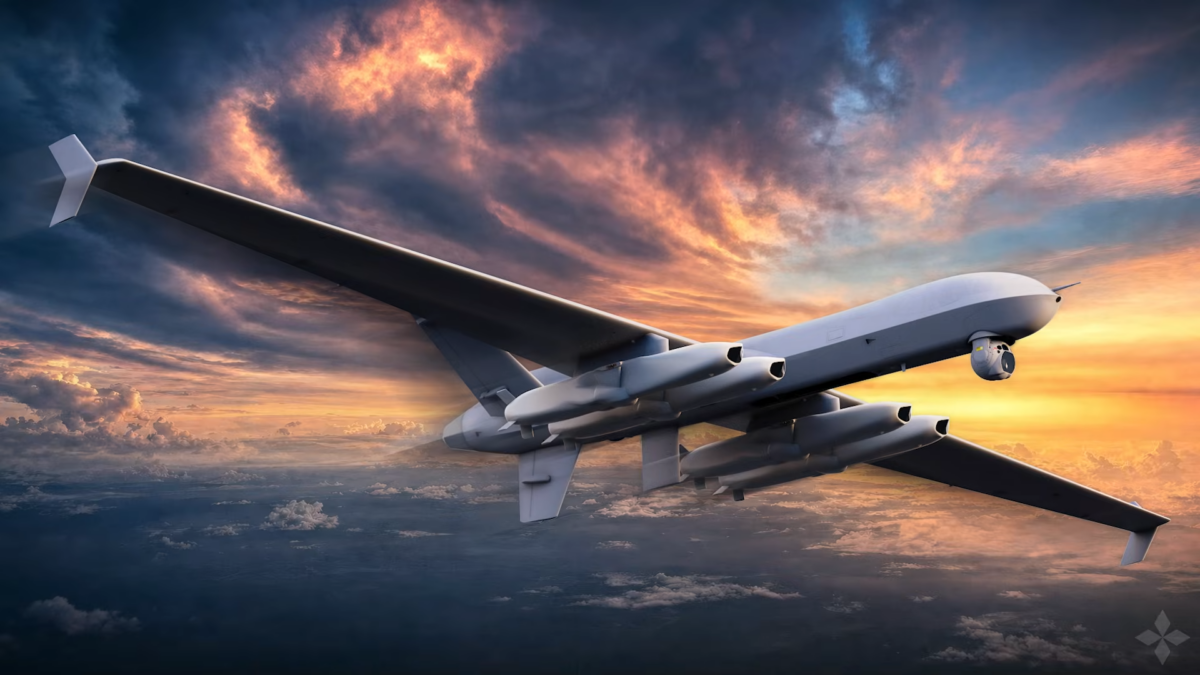
GA-ASI said Wildfire meets or exceeds every requirement within the solicitation. The company cited a ferry range beyond 14,800 kilometers (8,000 nautical miles) and claims that the aircraft can carry two Long Range Anti-Ship Missiles or four Joint Strike Missiles at once, among other combinations of weapons, sensors and launched effects.
GA-ASI President David R. Alexander declared that the MQ-9B would remain the company’s multi-mission aircraft, covering roles such as submarine hunting and airborne early warning, while Wildfire would concentrate on intelligence, surveillance, reconnaissance and strike. He described the design as tolerant of attrition.
“This is a high-volume, lower-cost airplane that does a few things really well,” Alexander said.
Autonomy designed to control dozens of aircraft at once
According to the company’s Wildfire page, operators will control the aircraft through government-provided autonomy software rather than a conventional ground control station.
The approach draws on GA-ASI’s work on the FQ-42A Collaborative Combat Aircraft, which the USAF moved into production in June 2026. GA-ASI said the software would allow collaborative control of dozens of Wildfires at once.
The company also promised that it could deliver Wildfire years ahead of the fiscal 2031 date set by DIU, using its existing manufacturing base and supplier network. In addition, GA-ASI is marketing the aircraft for civil and commercial work, including heavy cargo delivery.